Monday, February 23, 2015

SB89: A Constrained Vision for the Digital Classroom in Georgia

Leave it up to the Georgia General Assembly to take a promising concept, "The Digital Classroom Act," and ruin it with a purely reductive concept of digital learning coupled with a blatant disregard of what Georgia has been achieving with digital resources. The massive unfunded mandate contained in this bill further shows how out of touch our legislators are with the fiscal realities facing our schools.

The legislative approach is that of the middle school child who has discovered the "replace" command in Word. Let's just take out "textbook" and replace it with "digital materials and content"--because what the hey, it's the same thing, right? Replace all, tweak a little, and BAM, we have reshaped instruction in our state for a generation. Except we haven't.  If the intent is to replace textbooks with just electronic forms of textbooks, with linear, packaged materials that "constitute the principal source of study" for a course, then we are missing the pedagogical boat. The digital classroom our students deserve is one in which the teacher can connect students with a broad variety of digital content, selecting for each student the most appropriate resource for each individual's need.

Georgia has been working to that end to establish the Learning Object Repository with thousands of digital resources. Thanks to the hard work of Dr Christina Clayton and the staff of Georgia Virtual School, Georgia developed a massive repository of vetted digital resources. [Their work was accomplished on a shoestring at GaDOE, and it's a damn shame that GaDOE has since lost Dr Clayton's leadership in these endeavors]. Oblivious of this accomplishment, SB89 proposes to create an adoption process with committees of no more than 5 "educators actually engaged in public school work in this state."  And in their spare time, these five individuals are to chart the course for a statewide digital classroom?

Which brings us to "THE UNBELIEVABLY SWEET ALPACAS!"

Let's say a teacher of economics discovers the WetheEconomy series of 20 short films on economics--edgy enough to spark conversation in a high school econ class but founded in economic principles. Do the authors of SB89 intend for a teacher to wait for a resource to be approved by this committee of five educators?  Or that this same teacher be obligated to lobby for 20 or more teachers from 20 or more different school systems to request (in writing) for the resource to be added to the "approved list?"

From Curriki's repository of teacher-created resources to CK12's "roll-your-own" FlexBooks, open educational resources are the future for education. SB89 represents an unimaginative attempt to apply the moribund textbook adoption process to the dynamic explosion of digital resources. That tired and futile approach will fail Georgia's teachers and students.  

The state would be better served if the state hosted a platform on which teachers, students, and community members could recommend resources, tag them to a standard, and then the community of educators could vote resources up and down to collectively discover the best digital resources for our students. The state could build on what it already has in place with its Teacher Resource Link.  It's a rather radical idea, but let's just try trusting teachers this time--allow them to propose materials, to determine what is best for their respective students, and for the state to provide a framework to enable this to happen.

NOW ABOUT THAT UNFUNDED MANDATE

My school system--like most across the state who have endured years of austerity cuts--has made compromises to keep our budgets balanced. Computer hardware purchases were put off, as were network projects. The federal eRate program is promising some serious dollars for wireless networks, but that funding could take five years, with the out years still not yet funded.  On top of that, we are scrambling to build the infrastructure to support a statewide online testing program.

It takes tremendous gall for our legislators, who have provided barely any funds for technology in a decade to REQUIRE local boards of education to provide a device for every student by 2020. The Governor's Office of Student Achievement this past year asked school systems to estimate the cost to provide each student a device.  Let's have the legislature ask GOSA how many hundreds of millions of dollars this statewide mandate would impose on school systems.

I have seen schools that are making great strides toward implementing one-to-one device plans with their students, but those systems are, for now, the exception. Each system should be encouraged to develop a plan for meaningful integration of technology in a manner that best meets the needs of its students on a timetable that is determined by local boards of education--not by legislators.

Senators Albers, Beach, Hufstetler, Black, and Williams should explain this gem too: "All digital
instructional materials and content and any computer hardware, software, and technical equipment necessary to support such digital materials and content purchased by local units of administration with state Quality Basic Education Program funds or any other means of acquisition shall may remain the property of the local unit purchasing or acquiring them." Why strike "shall" and replace with "may"? At least we knew a local system could keep the textbooks it bought.  What is the implication here for devices purchased with state or even local funds?

To say that SB89 is a good faith effort would be to discredit the word "effort." This is an ill-informed, unimaginative proposal that would serve our students poorly and which imposes an enormous unfunded mandate upon local systems who are still struggling fiscally. These senators should venture out into the schools to see how innovative teachers use digital resources on a daily basis, and then they will realize that we need more than a textbook cliché to move forward in our state.




Saturday, February 21, 2015

Is Georgia Ground Zero for School Privatization Movement?

Will $250,000.00 buy a seat at the legislative table? Looking at the bills going into the hopper of the Georgia General Assembly this year, the answer is, "Well, of course it does!"

Citizens United ensured that political contributions =free speech, but some entities have the resources to speak louder on issues affecting the public schools of Georgia. Those groups buying the most access to Georgia's legislators are StudentsFirst, the American Federation for Children, Charter Schools USA, and K12 Inc. (Linked to each group is an article on their agenda or activities in education--there is a certain degree of irony to some of these innocuous-sounding names).

Not only did these entities contribute $1 million to political campaigns in Georgia in 2014, their spending is disproportionately high in our state--well over three times their spending in California and five times what they spent in Florida. [You can explore the chart at followthemoney.org from this link.] 


[Don't worry about North Carolina.  Somehow they managed a negative $4000.00 in donations from these groups.  Maybe someone wised up and returned a donation.]

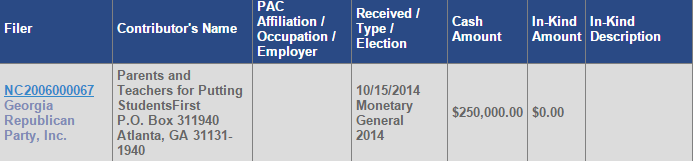
And who ran the table on these contributions last year?  The Georgia GOP took in a single donation of $250,000.00 from StudentsFirst Georgia.


And where does StudentsFirst Georgia get $250,000.00 to donate to the Georgia GOP? From Sacramento, California.
via the Georgia Government Transparency Campaign Finance Commission 


Georgia has become a target-rich environment for these ALEC-fueled entities and for-profit corporations. 

2014 contributions have borne fruit in 2015 with Governor Nathan Deal ($21,100.00 received) announcing his plan for an Opportunity School District à la Louisana RSD.  Senate Bill 133 sets out the plan for the statewide "Opportunity School District" with the powers to seize schools deemed to be failing with the option to turn them over to for-profit entities, and it found sponsors in Sens Jeff Mullis ($2000.00), Butch Miller ($1000.00) and Lindsey Tippins ($1000.00).

Of note is that more money flowed to the Georgia House where House Bill 243 would divert funds from the state's public schools into "Education Savings Accounts" that could be applied to a variety of expenses, including private school tuition or home school costs. That bill's sponsors racked up contributions from the privateers in 2014: Reps Mark Hamilton ($5750.00), Mike Dudgeon ($4000.00), Mike Glanton ($3500.00).

That is not to say these legislators have been bought or that they are selling their votes to the highest bidder. Moreso, these entities recognize a kindred spirit that will assist their efforts to undermine public education and divert funds from its support.

Georgians need to scrutinize closely the agenda of our legislators and the Georgia GOP when it attracts $1 million in inducements and rewards from groups dedicated to crippling our public schools and subverting the future of our children.


Tuesday, February 17, 2015

NOLA RSD Recommended Reading for Rep Stacey Abrams

Representative Abrams,
I read recently that you might be joining Governor Deal on a tour of the "miracle" that is the New Orleans Recovery School District, the model for his Georgia schools takeover and turnover plan.. This time of year must be very busy for you, so I took the liberty of collecting some background readings on the Recovery School District you might be visiting.

1, Be prepared for lots of discussions of "failing" schools being transformed.  The Christian Science Monitor laps up the New Schools for New Orleans narrative and regurgitates it well: "One measure regularly used in Louisiana is the Growth School Performance Score, which is based on test scores, graduation rates, and other factors. Based on those scores, in 2004-05 only 12 percent of students in New Orleans attended 'A' or 'B' schools while nearly 75 percent attended 'F' schools, reports New Schools for New Orleans (NSNO), a nonprofit that incubates and supports charter schools. By 2012-13, just 17 percent of students were in 'F' schools, while 34 percent were in 'A' or 'B' schools."  
New Orleans goes all in on charter schools. Is it showing the way?

Quite the rosy picture painted by New Schools for New Orleans.  Which is why you should read this, by statistician and Louisiana educator Mercedes Schneider: New Schools for New Orleans: Don’t You Believe It
[Mercedes Schneider is the woman you should meet to talk about Recovery Schools Districts and the statistical manipulation that props up its "success." She delves into the data from the Louisiana DOE and finds reality doesn't always match the narrative you might hear.]

Rep, Abrams, you also should give Georgia State prof Kristen Buras a call,  She can give you the full rundown on the shifting definition of  "failing" for Louisiana schools. Prior to Katrina, "failing" was 60 on the State Performance Scores.  Only by raising failing to 87.4 could the state capture all the schools it wanted for the New Orleans RSD.  Or as Professor Buras aptly put it: "'The success of the New Orleans charter school movement has been legislatively defined.  If you treat standards of what constitutes status of failure like a ping pong ball and continuously move it, then you can generate success or failure by shifting the definition."


Rep Abrams be very wary when someone compares the number of failing schools now to 2005 or to any time for that matter. If you are still interested in school letter grades, the appendix of this report from the Cowen Institute provides the latest, readjusted, inflated scores.  

2. When you start hearing a litany of statistics, listen closely for times when persons say "the New Orleans graduation rate" or "the New Orleans ACT scores." 

For example, here Schneider takes Leslie Jacobs to task for willfully conflating New Orleans with RSD schools and citing a misleading 76,5% graduation rate:

"First, one must consider the unclear term, “New Orleans.” This is the name of a city, not a school district. There is Orleans Parish Public Schools (those operating under the authority of the elected Orleans Parish School Board), and its 2010-11 graduation rate was 93.5 percent. This begs the question: Why focus on 76.5 percent as the evidence of “New Orleans success” instead of Orleans Parish Public Schools’ 93.5 percent? Furthermore, the OPSB received an “A” on its 2012 district report card. Why not highlight the achievements of OPSB?

The answer: The success of the OPSB schools only serves to underscore the failure of the state-run counterpart, RSD-NO."
New Orleans Recovery School District: The Lie Revealed, Part III

3. So what is the graduation rate for the RSD?  To tell the truth, that's up for debate.  A student leaving a school does not count as a dropout if the school has a record of the transfer actually happening.  On a state audit of exit codes, 0% of the RSD exit codes for transfers to another school could be documented. None of them.
School transfer data raises questions about accuracy of Louisiana dropout rates

So what would an RSD graduation rate be if the average is 76.5 and and OPSB graduation rate is 93.5%? The author of New Orleans high school exam results, graduation rate near state average observes:  "The decline in the city's 2013 four-year graduation rate was due entirely to the Recovery district schools [graduation rate of 59.5%]."

4. So are there any objective or national measures? Well, there is the ACT which is high stakes for Louisiana. A score of 17 qualifies a student for the TOPS scholarship and entrance to a two-year college, and a 20 qualifies a student for a TOPS scholarship entrance to a four-year university. Four out of five RSD takers of the ACT failed to qualify for any college.  As Mercedes Schneider observes, "This. Is. Not. Success" and she has posted an article addressed to you and your colleagues on this very point:

To Georgia Lawmakers: Louisiana Scholarship Eligibility Isn't Happening for State-run New Orleans Recovery School District (RSD) Graduates

5. I know Governor Deal is on his high horse about "failing" Georgia schools and their profligate spending of over $8400.00 per student. [You know, what Politifact Georgia called Half-True]. Can we know how much the RSD spends per child?

Based on 2010 NCES records, education.com reports, "The Recovery School District  spends $16,885 per pupil in current expenditures.  The district spends 41% on instruction, 55% on support services, and 4% on other elementary and secondary expenditures." The Tulane University Cowen Institute mingles Orleans Parish and RSD schools into one report, the State of Public Education for New Orleans and states a more modest $13,203.00 per student per year. Makes $8400.00 seem like a bargain, doesn't it?

Rep Abrams, this should give you something to review on your flight. I hope you are joining the Governor to make your own determination of the facts. The RSD has had almost a decade to improve the educational opportunities for these children, and that opportunity has been squandered.

I am sure there will be photo opportunities at which the governor's staff will maneuver you close behind him, as they did for the photos after your bipartisan collaboration on the two-tier HOPE program.  I trust that this time you distance yourself from this governor and his plans to reenact the turnover of public schools to corporate charters and that you act decisively for the best interests of Georgia's students by working with the Georgia Senate Democrats on their alternative bill to improve student chances for success.